September marks Childhood Cancer Awareness Month. Although childhood cancer is relatively rare, the incidence rate has been increasing. According to a 2014 report by the American Cancer Society, it is now estimated that one in 408 children worldwide will be diagnosed with cancer before the age of 15. Yet with early detection and treatment in paediatric oncology units, globally the survival rate can be as high as between 70% and 80%, with variance depending on the type of cancer.
Despite being relatively rare, in Western countries childhood cancer is the second most common cause of death in children aged 5 to 14 years, after accidents. In Africa it does not make it into the top 10 common causes.
It is estimated that currently less than half of children with cancer in South Africa are diagnosed, and many of those who are diagnosed are in advanced stage of illness. One of the reasons for this is a lack of awareness and knowledge in parts of the health system regarding the early warning signs of childhood cancer.
As a result, the Childhood Cancer Foundation South Africa (CHOC) initiated an Awareness Programme to disseminate the early warning signs that the South African Childhood Cancer Study Group drew up.
The objectives of the programme include ensuring that all children with cancer in South Africa are diagnosed as early possible and that the early warning signs of childhood cancer are well known in all parts of the health system (including primary healthcare clinics and all hospitals).
The internationally recognised symbol for childhood cancer is the gold ribbon. During Childhood Cancer Awareness Month (CCAM) each September, we encourage our supporters to wear a gold ribbon to help raise awareness.
Male breast cancer is rare, accounting for 1% of all breast cancers. It is a hundred times more common in women than in men.
Symptoms may include: a painless lump under the nipple or areola; an inverted nipple (turned inward); swelling of the breast tissue; a rash around the nipple; discharge or bleeding from the nipple; a swelling or lump in the armpit.
Bobby Were believed men could not be diagnosed with breast cancer, until he was!
Bobby Were: “I am a male breast cancer Survivor and this is my story. Whilst bathing one evening in 2006 I felt a pea size lump next to my right nipple. I called my wife and asked her to look. She agreed something was not right and that I should see the doctor. My male stubbornness kicked in immediately, You know what I mean, we men know much better than any doctor and I informed my wife it was nothing and I was fine.” Read more about Bobby’s acceptance of his diagnosis, and treatment…
It’s also important to know
about other cancers affecting men such
as HPV related cancers including penile and anal cancer. More than 30 to 40
types of HPV (Human Papilloma Virus) are typically transmitted through sexual
contact and infect the anogenital area, which in some cases, can result in
cancer.
Medical
male circumcision helps to reduce Human Immunodeficiency Virus (HIV)
acquisition and transmission, and is protective for Human Papilloma Virus (HPV)
in males, thus reducing the risk of initial or re-infection of HPV among women.
Coming in third is lung cancer with estimates that 1 in 82 SA men will develop lung cancer, according to the NCR 2017. When symptoms appear, they include shortness of breath, cough, a change in sputum, chest pain, noisy breathing, hoarseness, and coughing up blood. Screening may include examining the lungs with a fiberoptic telescope, sampling sputum for cancer cells or doing a CT scan. Read more about lung cancer…
CANSA
can assess your risk with a Smokerlyzer device – carbon monoxide is an
invisible, odourless, toxic gas formed during tobacco smoking. The Smokerlyzer
device is used to measure the exhaled air of the carbon monoxide levels and
guides as an awareness tool to educate and encourage quitting the use of
tobacco products, and also to be aware of being exposed to pollution and
secondary smoke.
If someone stops smoking, the risk of developing lung cancer falls dramatically and after approximately 15 years, the chance of developing the disease is similar to that of a non-smoker. In the event of a smoker quitting, health benefits may be experienced immediately…
Staff can also help guide you through the public health care system.Fact Sheet: Lung Cancer
4. Non-Hodgkin’s Lymphoma
Non-Hodgkin’s Lymphoma, is cancer of the lymphoid
tissue, which includes the lymph nodes, spleen and other organs of the immune
system. It is the fourth most common cancer and it is estimated that 1 in 160
SA men will develop Non-Hodgkin’s Lymphoma according to the NCR 2016.
Symptoms may include night sweats; itching; swollen lymph nodes in neck, underarms, groin or other areas; if cancer affects the brain headaches, concentration problems, personality changes or seizures may occur; fever and chills; weight loss; abdominal pain or swelling, which may lead to loss of appetite, constipation, nausea and vomiting; coughing or shortness of breath if the cancer affects the thymus gland or lymph nodes in the chest. Screening involves a doctor performing a physical exam and checking body areas with lymph nodes to feel if they are swollen. A biopsy of suspect tissue (usually a lymph node biopsy) will be done. A bone marrow biopsy may also be done.
Diagnosis & Support
If you suspect that you have
Non-Hodgkin’s Lymphoma, you need to contact your medical practitioner in order
that the proper screening tests be performed.
Staff can also help guide you through the public health care system.Fact Sheet:Non-Hodgkin’s Lymphoma
5. Bladder Cancer
And the fifth most common cancer in South African men is bladder cancer affecting 1 in 143 men, according to the NCR 2017. The largest risk factor that can be avoided is smoking, which doubles the chance of bladder cancer.
No
screening is available, however blood in the urine, a change in urine colour,
the need to go frequently and burning pain are some of the symptoms. Screening
tests may include cystoscopy, biopsy and laboratory and imaging tests.
Surgery
is the most common treatment. Additional treatments may include: administering
drugs directly into the bladder; chemotherapy or radiation therapy.
Staff can also help guide you through the public health care system.Fact Sheet: Bladder Cancer
Testicular Cancer
The lifetime risk for Testicular
Cancer in men in South Africa, is 1 in 1 737, according to the 2017 National
Cancer Registry.
Most
Testicular Cancers can be detected early – a lump or swelling may be the first
sign that a medical practitioner should be consulted.
Reduce Risk Through Self-Examination
It’s
important for young men to start
testicular self-examinations soon after puberty.
Men from
the age 15 to 49 years need
to examine their testicles each
month, preferably after a bath or shower, to feel for any
pea-sized lumps that could indicateTesticular
Cancer.
Learn
more about Testicular Cancer, symptoms, screening, self-examination and
reducing risk:
Staff
can also help guide you through the public health care system.
Testi-monials
to Encourage Men to Talk Balls – for their Health
Testi-monials,
a campaign created by FCB Cape Town for CANSA which is setting out to remove
the awkwardness around talking about testicular cancer, and drive awareness
about how important it is that men not only talk balls but take care of them
too.
The campaign features testicles giving their own testi-monials about cancer and how they have been personally affected. They will give advice on how to self-examine and help detect signs and symptoms. Read more…
Testi-monials
will live on www.testi-monials.co.za where people can
ask the campaign’s testi-ambassador their health related questions, including:
How is testicular cancer
diagnosed?
What are the treatments for
testicular cancer?
What are the symptoms of
testicular cancer?
And many other pertinent
questions relating to testicular cancer…
The
testi-ambassador will give it to you straight, so there’s no need to beat
around the bush.
In June
2016 the CANSA Testi-monial video won a Silver Cannes Lions Award and in August, the
video won three local Loerie
Awards. The Loeries are awards granted locally for local
advertising excellence in South Africa.
The five leading types of cancer that indiscriminately afflict men in South Africa are:
Prostate, Colorectal, Lung, Non-Hodgkin’s Lymphoma and Bladder Cancer
1. Prostate Cancer:
The lifetime risk for Prostate Cancer in men in South Africa, is 1 in 16, according to the 2017 National Cancer Registry.
Prostate cancer, is the most common male cancer globally and locally and showing significant increases. International and local research indicates that the risk for aggressive prostate cancer is higher in black men.
The prostate is a walnut-sized gland of the male reproductive system, located just below the bladder. Prostate cancer often grows very slowly and may not cause significant harm, but some types are more aggressive and can spread quickly without treatment. In the early stages, men may have no symptoms. Later, symptoms can include frequent passing of urine, especially at night; difficulty starting or stopping urination; weak or interrupted urinary stream; painful or burning sensation during urination or ejaculation; blood in urine or semen. Advanced cancer can cause deep pain in the lower back, hips, or upper thighs.
Risk factors for prostate cancer include age, ethnicity, family history, being obese or overweight and some dietary factors appear to increase risk. Men can lower their risk of prostate cancer by eating a healthy diet (including lots of fruit and vegetables), maintaining a healthy weight and limiting red meat and high fat dairy products.
Prof Riana Bornman, Senior Research Professor at the University of Pretoria’s School of Health Systems and Public Health and Prof Vanessa Hayes, a Genomicist from the Garvan Medical Institute for Medical Research in Sydney, Australia, focused their research on prostate cancer men of black and Khoisan descent in Southern Africa to better understand the possible links between prostate cancer and African ancestry.
Bornman states, “The most common risk factors include African ancestry, increasing age (from 50’s onwards) and a family history of prostate cancer – on either the mother or father’s side. It might be that prostate cancer grows more rapidly in black than in white men and that transformation from latent to aggressive prostate cancer might occur earlier in black men. Rural men especially may present late and with advanced disease. Men who were biopsied for prostate cancer will be registered in the National Cancer Registry database in South Africa, however, there’s currently no registry for prostate cancer cases that were diagnosed without a biopsy. Therefore, the numbers reported for prostate cancer in South Africa are likely an underestimate of the real numbers occurring. Annual prostate specific antigen (PSA) testing is essential to help detect prostate cancer early, through a simple blood test and this is currently not routinely measured in men presenting at public hospitals.”
CANSA is investing in research in the high incidence of prostate cancer and is funding the Southern African Prostate Cancer study (SAPCS) conducted at the University of Pretoria. This study will contribute to understanding of prostate cancer risk, disease progression and outcomes specifically in the South African population. CANSA is also coordinating the IRONMAN (International Registry for Men with Advanced Prostate Cancer) study, funded by Movember Foundation and sponsored by the Prostate Cancer Clinical Trials Consortium. It will contribute to a large global study of 5000 men, evaluating the treatment and patient-reported outcomes for men with advanced prostate cancer.
Men need to go for simple screening tests to detectProstate Cancer (see guidelines below). Screening results in early detection, enabling more effective treatment and a better chance of recovery:
Routine Prostate Specific Antigen (PSA) testing, annually, from age 40 for all men at high risk of prostate cancer. This includes those men with more than one first-degree relative (father, brother or son) who had prostate cancer at an early age (younger than 65 years). Another risk factor to be aware of, is the potential increased risk for prostate cancer developing when there a family history of first-degree female relatives diagnosed with breast cancer linked to BRCA1 or BRCA2 gene mutation (first degree relatives include a mother, grandmother, sisters and aunts).
Routine Prostate Specific Antigen (PSA) testing, annually, as from age 45 for all males who are at risk of prostate cancer. This includes men who have a history of prostate cancer on either the mother or father’s side, or with a first-degree relative (father, brother, or son) diagnosed with prostate cancer at an early age (younger than 65 years)
Routine Prostate Specific Antigen (PSA) testing, at least once every two (2) years, for all males from age 50
Reduce Risk Through Screening:
Although most enlargements of the prostate are not cancerous, regular screening is essential.
Prostate Specific Antigen (PSA) Test
Prostate Specific Antigen (PSA) is a protein produced by both cancerous (malignant) and non-cancerous (benign) prostate tissue. High PSA levels may indicate inflammation of the prostate or even cancer.
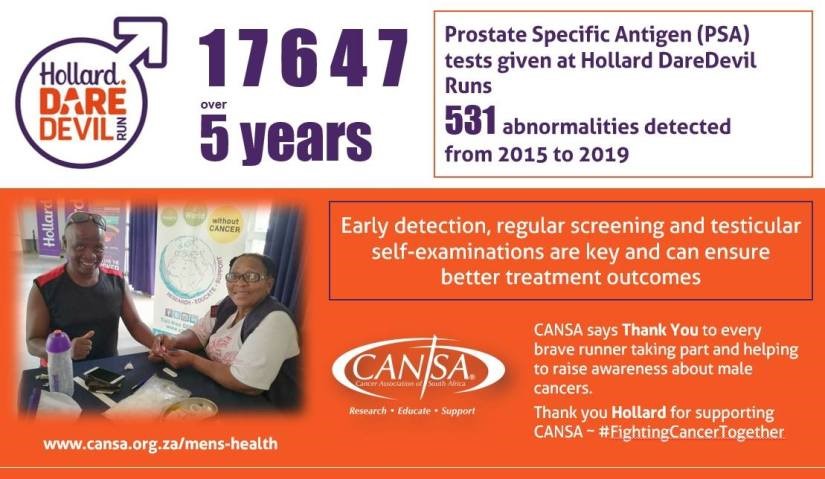
Total over the period 2015 – 2020: 20 015 tests done; 572 abnormalities detected, potentially helping to save 572 lives!
2020 – We’re thrilled to announce that our ‘Don’t fear the Finger’ video promoting awareness of Prostate Specific Antigen (PSA) tests and our Men’s Health programme, has won two awards presented by the Loeries! ‘Don’t Fear the Finger’ won Bronze in the Digital Social Media for HelloFCB+ and a Gold in the Film – TV & Cinema Commercials. We’re so grateful to HelloFCB+ the advertising agency that made the video for CANSA all at no cost. It’s great to have partners like them on board to help fight cancer.
Digitial Rectal Exam
Men aged 50 (40 – 45 for those at high risk, such as men with a family history of Prostate Cancer) should be examined annually.
A doctor examines the prostate through the rectum to check for any prostate lumps or abnormalities.
Learn more about Prostate Cancer, symptoms, screening and reducing risk:
Athlone Grootboom, prostate cancer Survivor and member of CANSA Survivors – Champions of Hope Facebook Support Group: “Prostate cancer is not a walk in the park. I was diagnosed 3 and a half years ago. I went through several surgeries, tests, radiation and chemotherapy with its side effects. It’s a long road and a learning process. It’s better to get the recommended PSA tests!”
Dennis Feldman, prostate cancer Survivor, and member of CANSA Survivors – Champions of Hope Facebook Support Group: “My physician included a PSA test when I turned 50. At age 60 he called me to say I had elevated PSA levels and should see my urologist. After a biopsy six months later, I was diagnosed with early stages of prostate cancer. I HAD NO SYMPTOMS WHATSOEVER. If my physician had not annually included the PSA test, I would not have known I had cancer. I had surgery in 2012 and have had a PSA of 0.02 since then. I have had NO side effects. EARLY DETECTION IS A MUST. Many men are afraid to have a PSA test – please don’t; it can save your life.”
Gavin Tearne, prostate cancer Survivor and member of CANSA Survivors – Champions of Hope Facebook Support Group: “My PSA count doubled at age 54. Every male should go for yearly check up!”
* A paper published in 2014 examining the number of prostate cases diagnosed and deaths, showed significant increases than in previous years. (Babb C, Urban M, Kielkowski D, Kellett P. Prostate cancer in South Africa: pathology based national cancer registry data (1986–2006) and mortality rates (1997–2009). Prostate Cancer. 2014;2014.)
Colorectal cancer (cancer of the colon or rectum), is the second most common cancer and it is estimated that 1 in 74 SA men will develop colorectal cancer according to the NCR 2017. Read more about CANSA’s Colorectal Cancer Awareness and Support Campaign…
Should men experience abnormal symptoms, they should request a referral for a colonoscopy to screen for cancer. CANSA recommends a colonoscopy from the age of 50, every 10 years and earlier if there is a history of colorectal cancer.
In early stages symptoms are not present, however when they do occur, they may include:
change in bowel habits (diarrhoea / constipation / consistency of stools)
rectal bleeding or blood in stools
persistent abdominal discomfort (cramps, gas or pain not related to diet)
a feeling that the bowel does not completely empty
weakness or fatigue
unexplained weight loss
Treatment depends on how far the cancer has advanced and may include surgery, radiation, chemotherapy, or a combination of these therapies.
Risk factors: a family history of colorectal cancer; a personal history of inflammatory bowel disease; colorectal polyps, consumption of red & processed meats; low fruit & veg intake; low-fibre & high-fat diet; excess body weight; alcohol consumption; insufficient intake of clean, safe water; smoking, physical inactivity and exposure to chemicals. CANSA advises living a balanced lifestyle to reduce risk of colorectal cancer.
CANSA provides Faecal Occult at home stool tests (R100), which can be done at home. If the test is positive (visible red line on test strip) for the presence of blood in the stool, CANSA provides a referral letter to request a colonoscopy.
A side effect of colorectal cancer may include having a colostomy. Many colorectal cancer patients have a portion of their bowel and / or colon removed and end up with a permanent stoma. A stoma is an opening on the abdomen that can be connected to the digestive or urinary system to allow waste to be diverted from the body. It can take a while for a patient to adapt to living with a stoma, so it’s important to seek support from CANSA.
CANSA offers professional pre- and post-operative counselling and support groups at our Stoma Clinics and Stoma bags and linen savers can be purchased at reduced prices at most local CANSA Care Centres. CANSA provides stock of the biggest stoma brands and guarantees the lowest prices, professional assistance and speedy delivery.
NB: Where a CANSA Care Centre is not equipped to provide the above-mentioned service, patients will be referred to reliable service providers in their local community.
The CANSA Tele Stoma Support Service offers online consultations for stoma patients and their families to assist with challenges or stoma queries. Make an appoinment on 0800 22 66 22.
Staff can also help guide you through the public health care system.